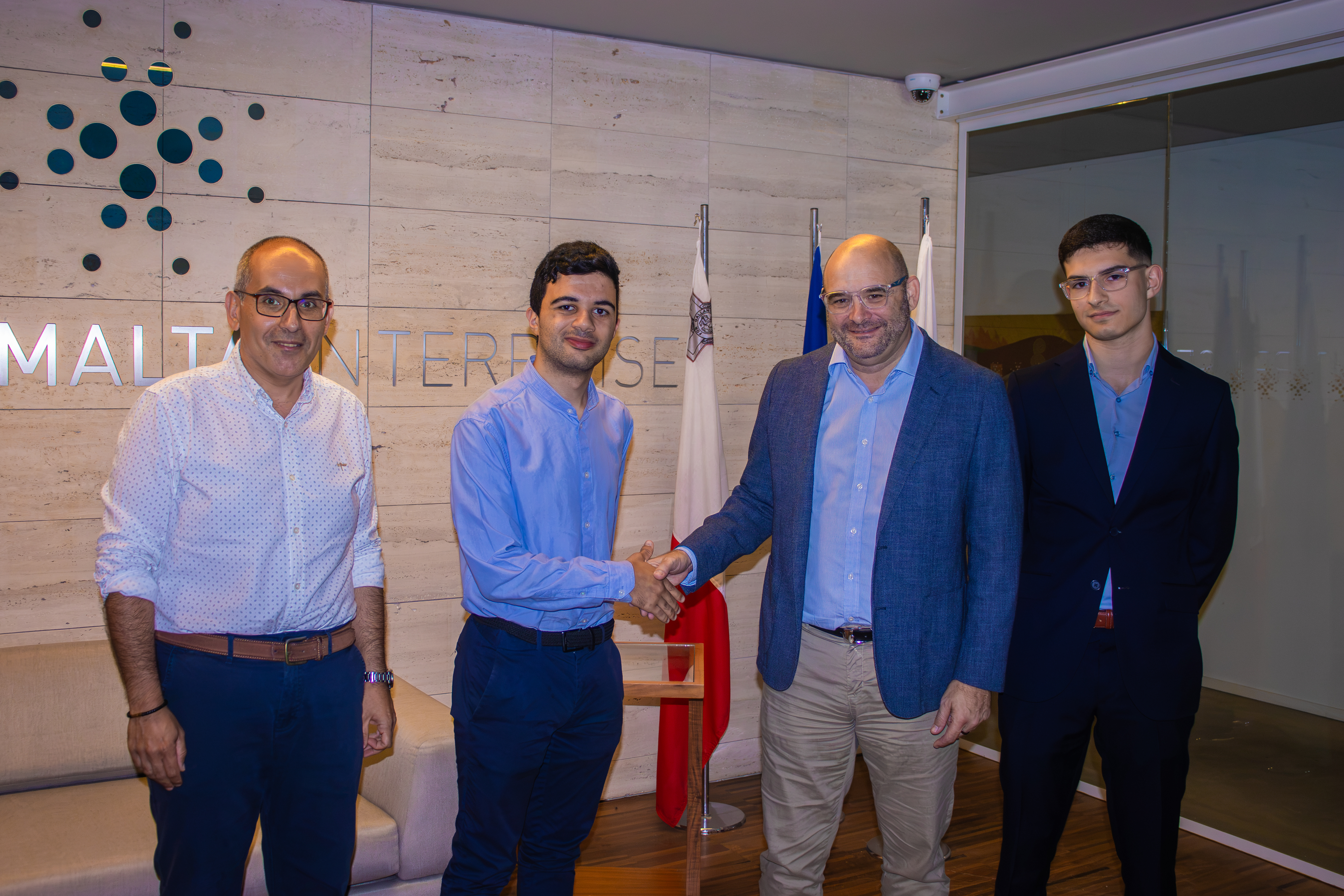
On Thursday, 20 August 2026, two Master of Science (MSc) students from the University of Malta met with Mr George Gregory, CEO of Malta Enterprise. The two students, Mark Zammit and James John Gatt, are pursuing an MSc in ICT, with a specialisation in microelectronics and microsystems.
Through an internship sponsorship at imec’s headquarters in Leuven, Belgium, the students have the opportunity to conduct research in microelectronics while completing their research projects with the University of Malta.
Speaking about his experience, Mark Zammit explained that his research conducted during the time of his internship focused on the compensation of power-amplifier distortion in 6G communication systems. He was supervised by Prof. Inġ. Owen Casha from the Department of Microelectronics and Nanoelectronics at the University of Malta and mentored by Dr Meng Li at imec. Zammit is currently finalising his dissertation and aims to publish his findings in a peer-reviewed conference paper.
Reflecting on his time abroad, Zammit described his experience at imec as enriching from both a professional and a personal perspective. Indeed, he had frequent meetings with his supervisory team, who offered consistent guidance, thus helping him to foster a sense of responsibility in his work. Beyond this academic aspect, Zammit noted that students studying at imec can participate in a range of recreational activities.
Listening to Zammit’s experience, James John Gatt wholeheartedly looks forward to his internship, which is set to start in September. His research will focus on advanced sub-terahertz packaging solutions to address power and bandwidth bottlenecks in modern data centres, high-performance computing systems and cloud infrastructure. Additionally, Gatt aims to optimise high-speed and mixed-signal interposers for co-packaged optics, enabling ultra-low-loss, high-density electrical interconnections between application-specific integrated circuits, driver integrated circuits and photonic integrated circuits. Through this experience, Gatt plans to make use of imec’s advanced research platforms to design, enhance, and simulate highly energy-efficient, high-speed SerDes channels and embedded passive components. His work will contribute to the development of next-generation technologies for high-speed data transmission. During his internship, Gatt will work closely with his mentor, Dr Xiao Sun, at imec, and his supervisor, Prof. Inġ. Owen Casha.
While both students have clearly defined academic goals and research ambitions, an important question remains: what is imec, and how did it become a collaborative partner?
Founded in 1984, imec has grown into the world’s largest independent research and innovation centre for nanoelectronics and digital technology. The organisation leverages a unique research and development (R&D) infrastructure, supported by a growing community of researchers and experts working in areas such as advanced semiconductor technologies and system scaling, silicon photonics, artificial intelligence, beyond-5G communications, sensing technologies, health and life sciences, mobility, Industry 4.0, agrifood, smart cities, sustainable energy, and education.
In a memorandum of understanding (MoU) signed in Malta in 2024, imec and Malta Enterprise outlined their cooperation on semiconductor research by linking imec’s advanced pilot-line infrastructure with Malta’s Competence Centre. Both parties expressed a shared commitment to establish a long-term and sustainable partnership in advanced semiconductor technologies.
This collaboration has created new opportunities for students at Maltese education institutions, including the University of Malta and the Malta College for Arts, Science and Technology (MCAST), to undertake part of their Master’s and PhD research programmes at imec. Such initiatives strengthen local research capabilities while providing students with exposure to world-class facilities and expertise.
Speaking on the strategic direction Malta Enterprise is pursuing in the semiconductor sector, George Gregory, CEO of Malta Enterprise, emphasised that developing the skills and specialised talent needed to support Malta’s industrial ecosystem is a key priority. Through strategic partnerships such as our collaboration with imec, we are creating opportunities for Maltese students and researchers to gain exposure to world-class semiconductor research and infrastructure, while strengthening the skills base needed to support Malta’s long-term ambitions in the semiconductor sector.
The Department of Microelectronics and Nanoelectronics within the University of Malta welcomes and strongly supports internship sponsorship initiatives of this kind. Such opportunities enable postgraduate students to broaden their knowledge and develop advanced technical and research skills while applying them in a highly collaborative, internationally recognised research environment.
The partnership demonstrates the successful implementation of the 2024 agreement and reflects Malta’s commitment to advancing its capacities in semiconductor research and innovation. More broadly, it supports the Government of Malta’s Vision 2050 by fostering knowledge transfer, innovation and the development of highly specialised talent in strategic technological sectors.